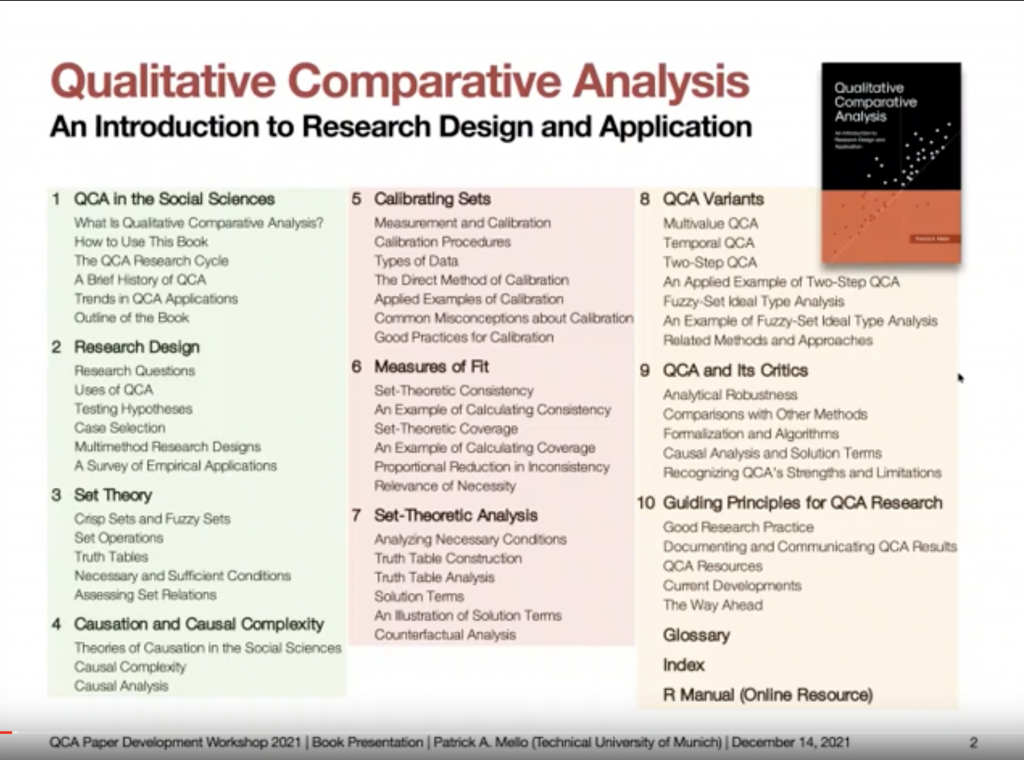
The COMPASSS Network made some material from the last QCA Expert Workshop at ETH Zurich available on YouTube. This includes a 20-minute summary and some Q&A on my book Qualitative Comparative Analysis: An Introduction to Research Design and Application (Georgetown UP, 2021). This part starts in minute 12 of the recorded session (see the video link below).
Annual Convention of the International Studies Association (ISA), Nashville
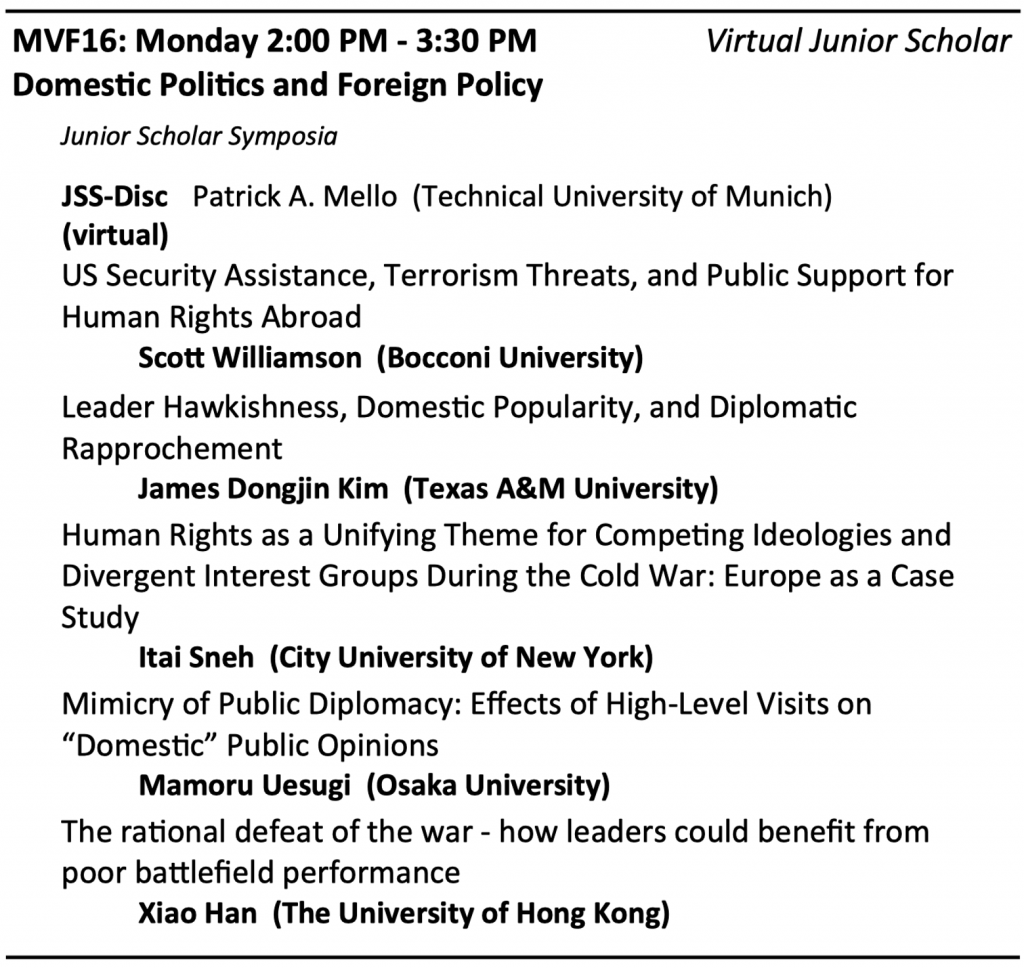
From March 28 to April 2, 2022, the Annual Convention of the International Studies Association (ISA) took place in Nashville, Tennessee, USA. I participated virtually, serving as discussant on the panel “Domestic Politics and Foreign Policy” for the Junior Scholar Symposia, with contributions on a range of phenomena linked to international security, including military assistance, battlefield performance, and the relationship between leaders’ childhood experiences and their foreign policy behavior once in office.
Beyond that, the DVPW group on Foreign and Security Policy held an informal meeting at ISA (see the group’s Twitter account) and the Foreign Policy Analysis Methods Café saw its 4th installment as part of the conference program.
Open Access Article Published in Global Policy
Persistence Against the Odds: How Entrepreneurial Agents Helped the UN Joint Inspection Unit to Prevail
Global Policy published an open access article that draws on research from our DFG project on “International Bureaucracies and Agency Slack” (with Eugénia da Conceição-Heldt, Anna Novoselova, and Omar Ramon Serrano Oswald). The article “Persistence Against the Odds: How Entrepreneurial Agents Helped the UN Joint Inspection Unit to Prevail” draws on delegation theory and historical institutionalism to examine how and why the Joint Inspection Unit (JIU) persisted despite witnessing several existential challenges to its survival.
We thank current and former inspectors and officials of the United Nations System who were exceedingly generous with their time and resources. The interviews conducted were essential to the research for this article. We also acknowledge the generous support of the German Research Foundation under DFG project number 370183851. Open access funding was enabled and organized by Projekt DEAL.
Abstract: Since its inception in 1966, the United Nations Joint Inspection Unit (JIU) has prevailed in the face of significant existential challenges. Against this backdrop, we investigate how and why the JIU persisted over time. Combining delegation and historical institutionalist approaches, we posit that entrepreneurial agents and layering processes together help us better understand persistence of inter-national organizations. Based on semi-structured interviews with UN staff and JIU inspectors, we examine three critical junctures in the history of the JIU. Our results show that entrepreneurial agents and stakeholders in the JIU managed to avoid the closure or demotion of the JIU by engaging in a strategy of institutional layering. Our analysis, however, also demonstrates that the JIU survived at the price of losing its privilege as the central UN oversight body. These findings have implications for the study of international organizations and for the reform of the UN system at large.