Leadership Traits and Political Beliefs in German Foreign Policy
Book review published in German Politics
On December 21, 2020, German Politics (Taylor & Francis) published my book reviewof Entscheidungsträger in der deutschen Außenpolitik: Führungseigenschaften und politische Überzeugungen der Bundeskanzler und Außenminister (Nomos) by Christian Rabini, Katharina Dimmroth, Klaus Brummer, and Mischa Hansel.
From the review: “In sum, this book offers a compelling account of German leaders and their foreign policies, based on meticulous research and a systematic application of leadership profiling. The book’s methods should stimulate wide application in the field of foreign policy analysis, and beyond.”
Patterns of Political Ideology and Security Policy
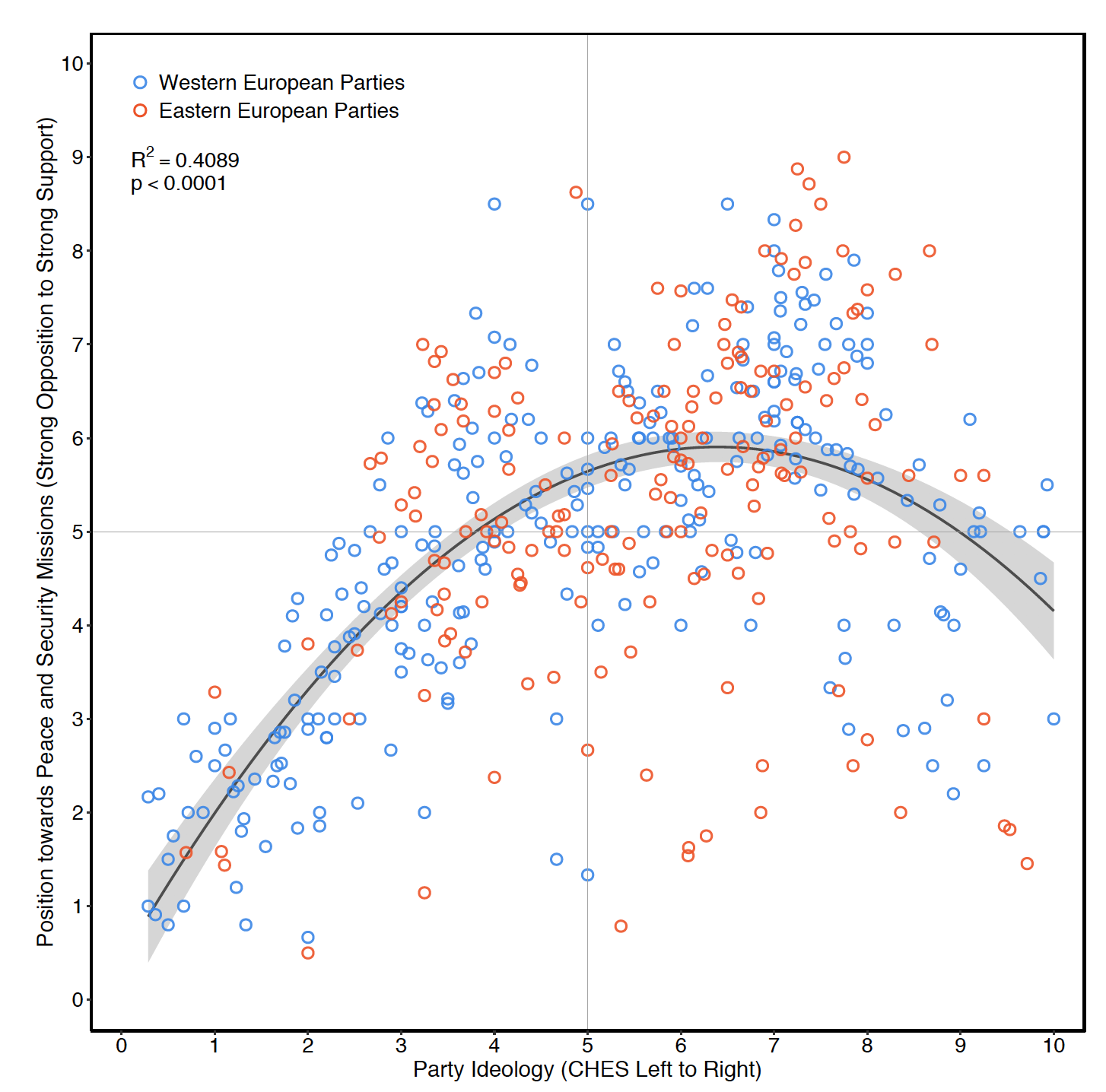
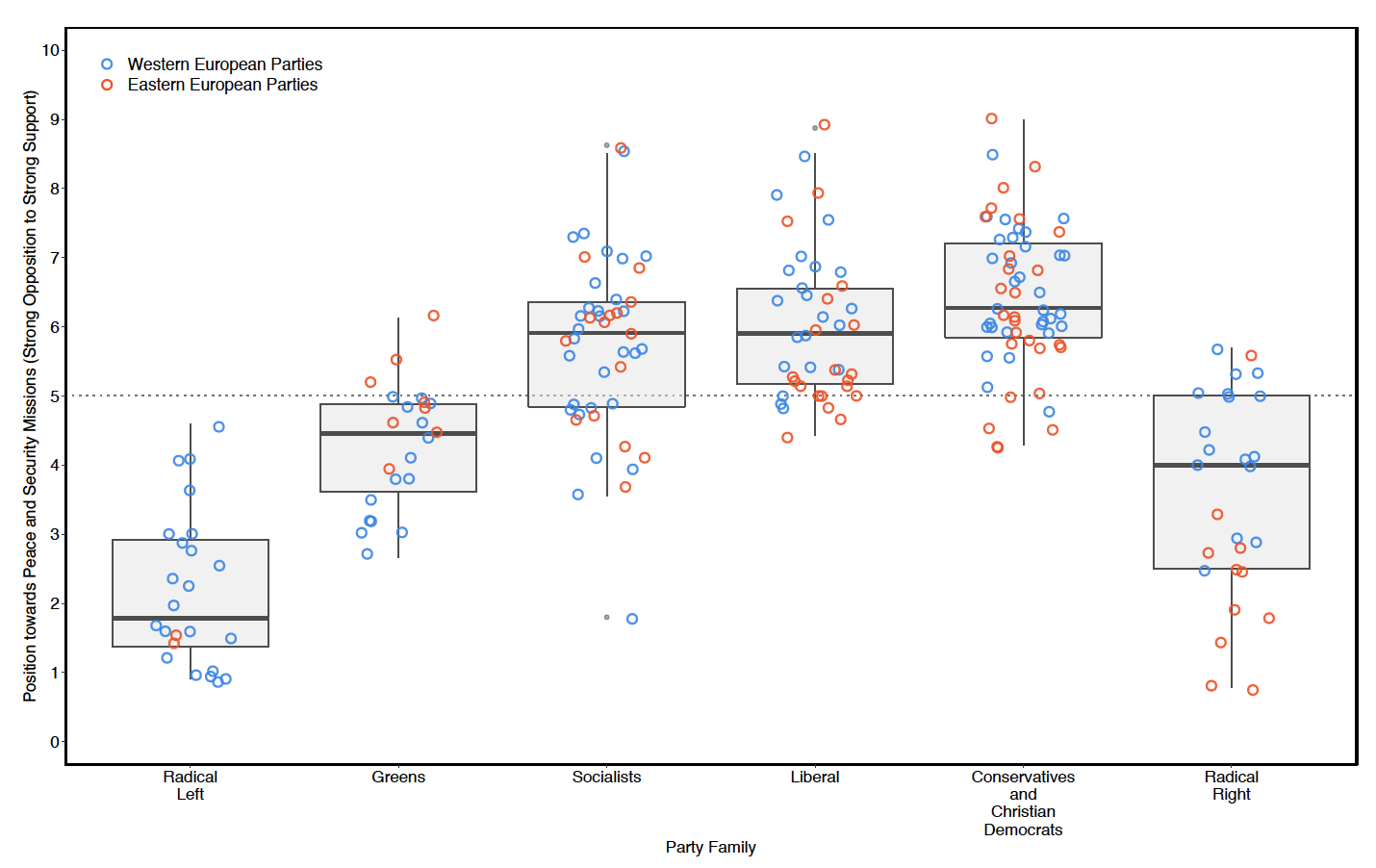
The October 2020 issue of Foreign Policy Analysis (Oxford University Press) includes the article “Patterns of Political Ideology and Security Policy” by Tim Haesebrouck and me. In the article, we examine the relationship between the ideology of political parties and their general support for military missions. Empirically, the study confirms a curvilinear relationship: with support peaking among center-right parties and dropping the further one moves to the far-left and far-right. However, when looking at actual military participation the pattern is different. Here, left-of-center parties have deployed to military missions more often than their rightist counterparts. Founded in 2005, Foreign Policy Analysis(FPA) aims to serve “as a source for efforts at theoretical and methodological integration and deepening the conceptual debates throughout this rich and complex research tradition”. The journal is published by Oxford University Press under the auspices of theInternational Studies Association (ISA).
Abstract: Recent studies on political ideology suggest the existence of partisan divides on matters of foreign and security policy – challenging the notion that “politics stops at the water’s edge”. However, when taken as a whole, extant work provides decidedly mixed evidence of party-political differences outside domestic politics. This article first conducts a systematic empirical analysis of the relationship between parties’ left-right positions and their general attitude towards peace and security missions, which suggests that right-leaning parties tend to be more supportive of military operations. Yet, the results also show that the empirical pattern is curvilinear: centrist and center-right parties witness the highest level of support for military missions, while parties on both ends of the political spectrum show substantially less support. The second part of our analysis examines whether the stronger support of rightist parties for peace and security missions translates into a greater inclination of right-wing governments to actually deploy forces to military operations. Strikingly, our results suggest that leftist governments were actually more inclined to participate in operations than their right-leaning counterparts. The greater willingness of left-wing executives to deploy military forces is the result of their greater inclination to participate in operations with inclusive goals.
Democracies and Withdrawal from Iraq
Open Access Article Published in EJIS
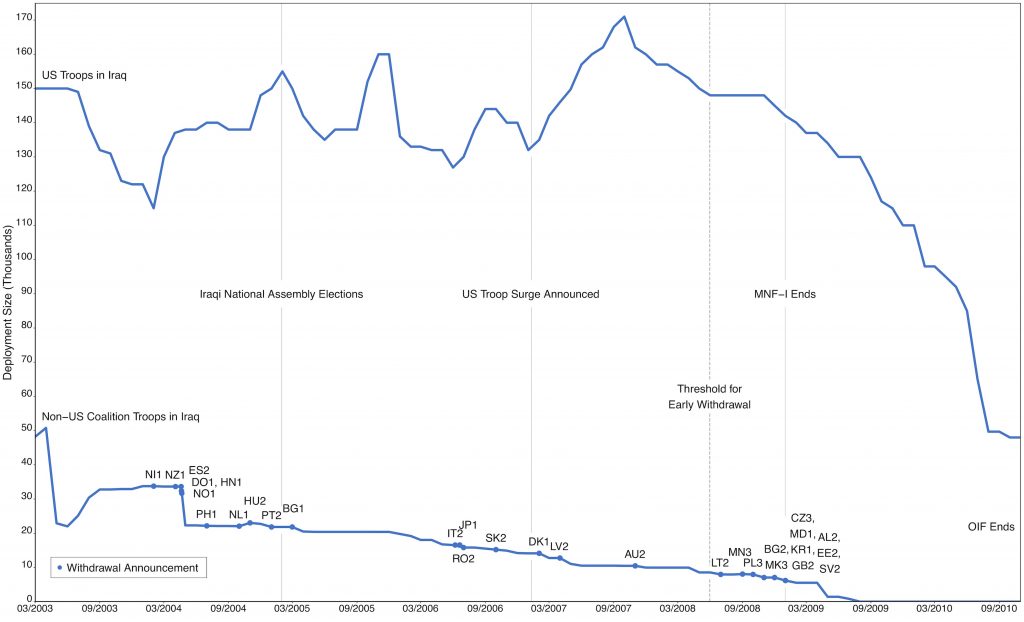
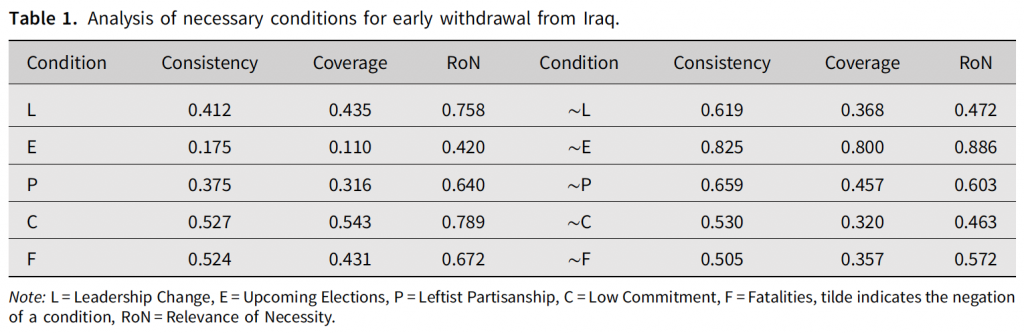
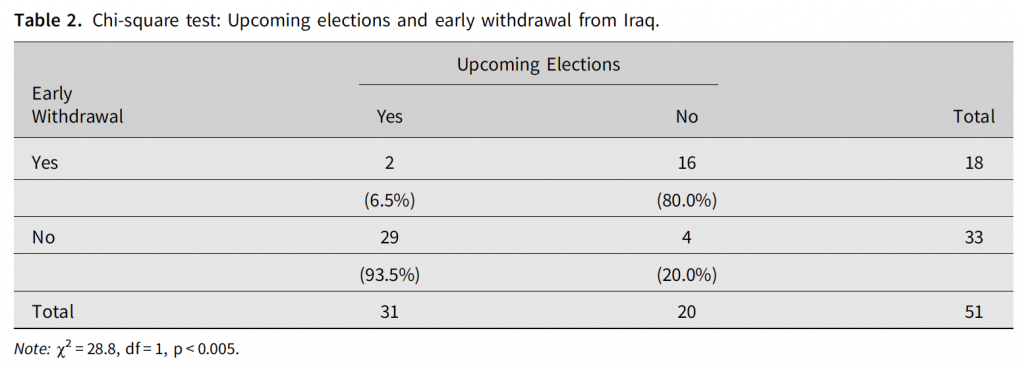
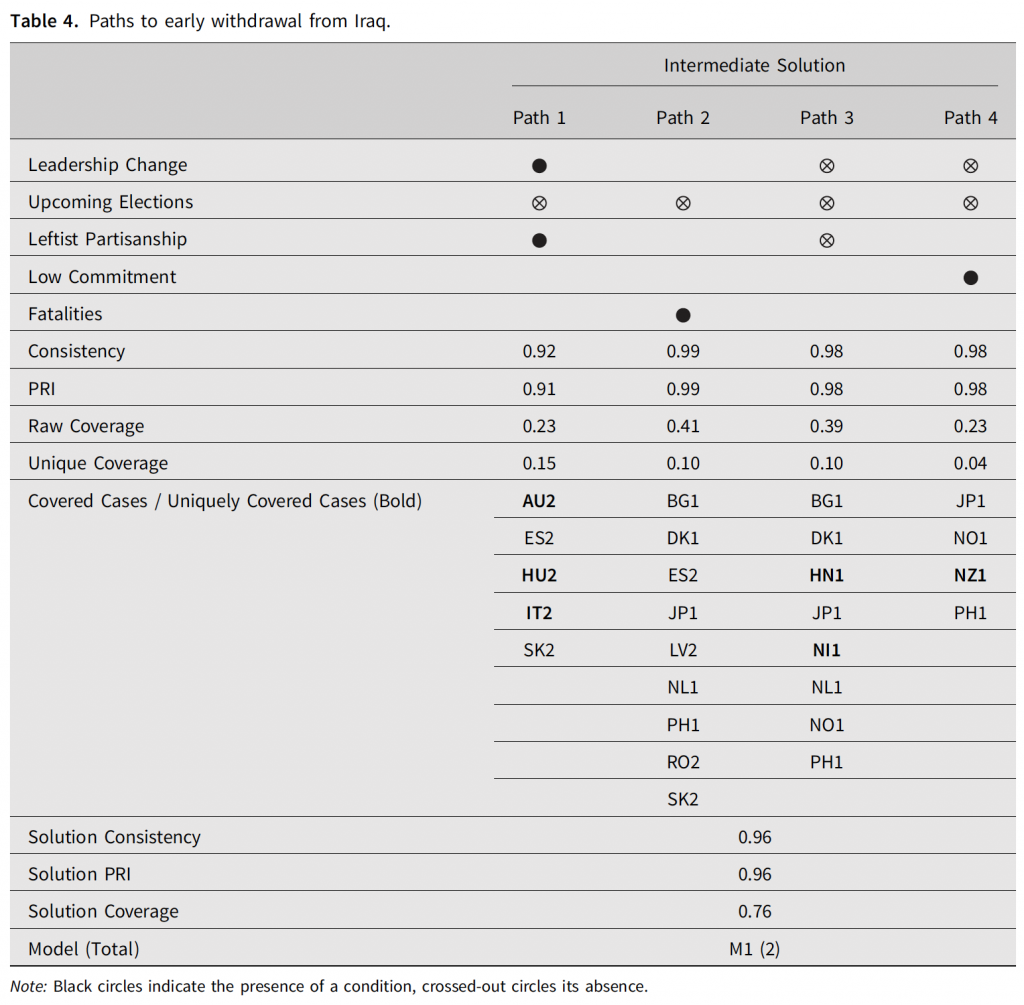
The February 2020 issue (5:1) of the European Journal of International Security (Cambridge University Press) features the article “Paths towards Coalition Defection: Democracies and Withdrawal from the Iraq War“. The study examines democratic war involvement in Iraq across 51 leaders from 29 countries. The article is the first QCA study that covers the entire period of coalition operations in Iraq, from 2003 until 2010, across all democratic governments that were involved in the multinational coalition. Among other findings, the article challenges some previous studies’ results on the effects of leadership turnover and electoral incentives (here and here). The set-theoretic analysis documents causal heterogeneity, where multiple paths lead towards coalition defection and leadership turnover only brought about the outcome of coalition withdrawal when combined with specific other conditions. For electoral incentives, contrary to expectations derived from prior studies, it could not be shown that upcoming elections were associated with coalition defection. Finally, the article documents the importance of casualties and prior commitment as factors that had previously been neglected. Replication data is hosted a Harvard Dataverse (R script, data, supplement).
Abstract: Despite widespread public opposition to the Iraq War, numerous democracies joined the US-led multinational force. However, while some stayed until the end of coalition operations, and several increased their deployments over time, others left unilaterally. How to explain this variation?
While some studies suggest that democratic defection from security commitments is primarily motivated by electoral incentives or leadership change, scholars have not reached a consensus on this issue. To account for the complex interplay between causal factors, this article develops an integrative theoretical framework, using fuzzy-set Qualitative Comparative Analysis (QCA) on original data on the Iraq War involvement of 51 leaders from 29 democracies.
The findings document the existence of multiple paths towards coalition defection. Among others, the results show that: (1) leadership change led to early withdrawal only when combined with leftist partisanship and the absence of upcoming elections; (2) casualties and coalition commitment played a larger role than previously assumed; and (3) coalition defection often occurred under the same leaders who had made the initial decision to deploy to Iraq, and who did not face elections when they made their withdrawal announcements.
Reference:
Mello, Patrick A. (2020) Paths towards Coalition Defection: Democracies and Withdrawal from the Iraq War, European Journal of International Security 5 (1): 45-76 (https://doi.org/10.1017/eis.2019.10)