• Democracies and Withdrawal from Iraq

    Open Access Article Published in EJIS

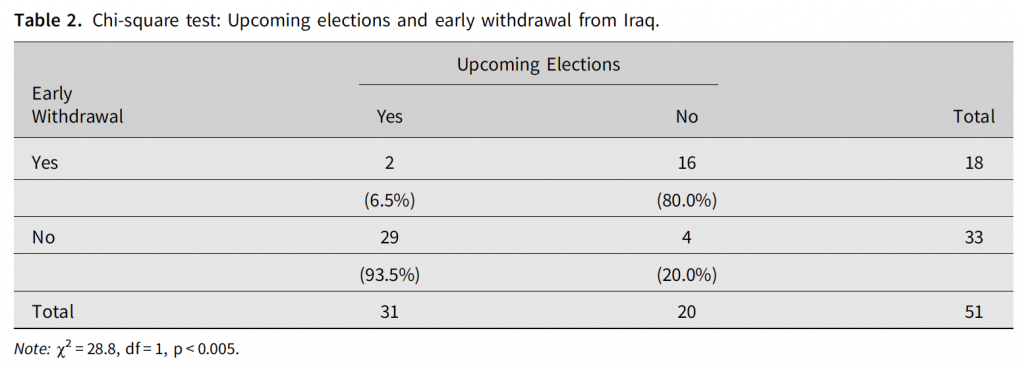
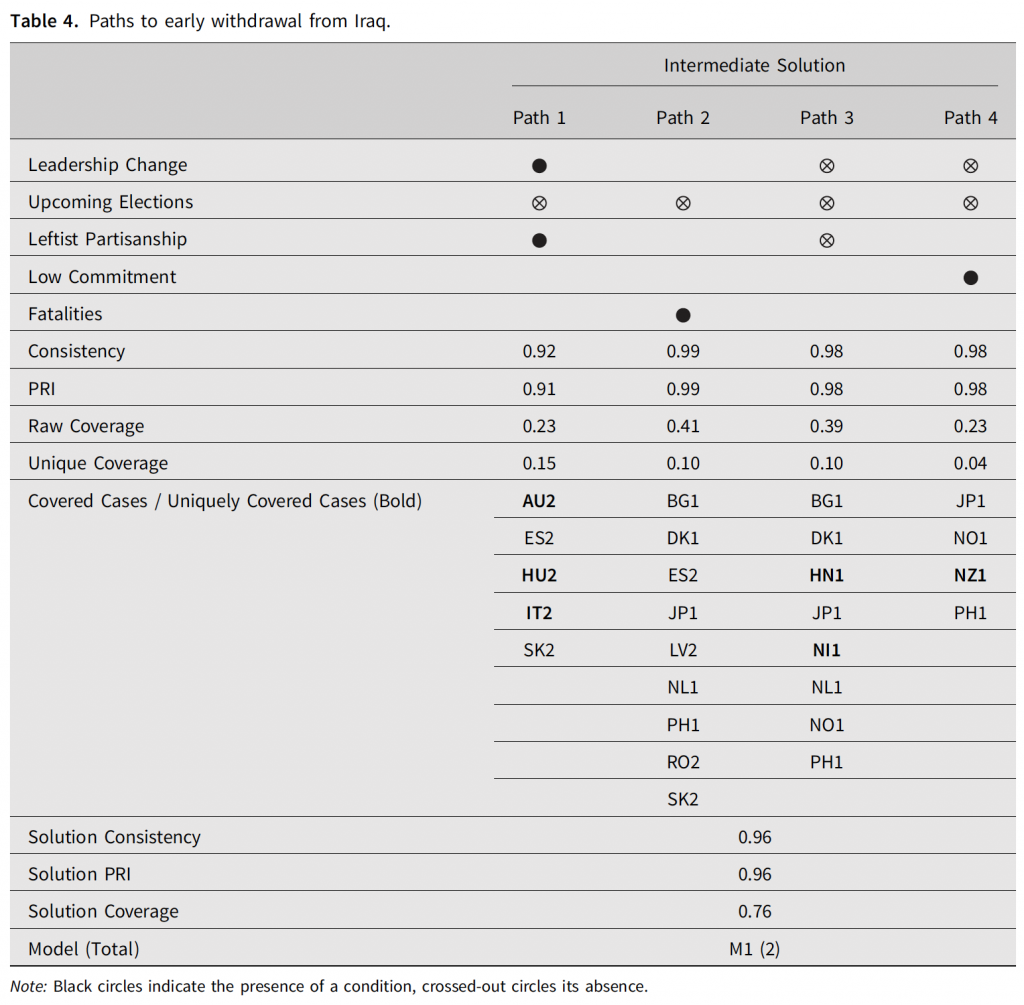
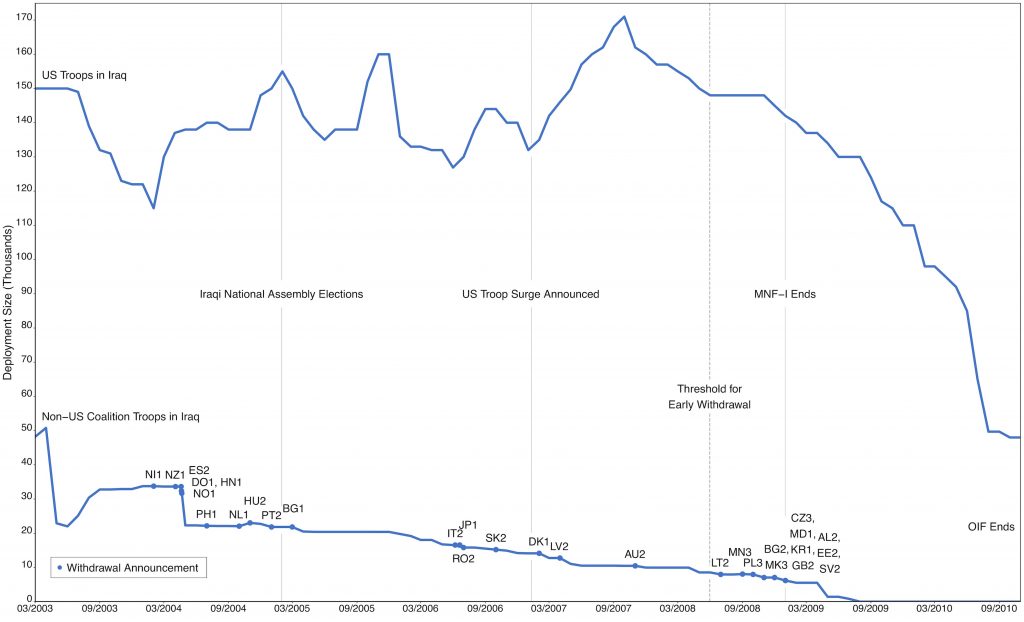
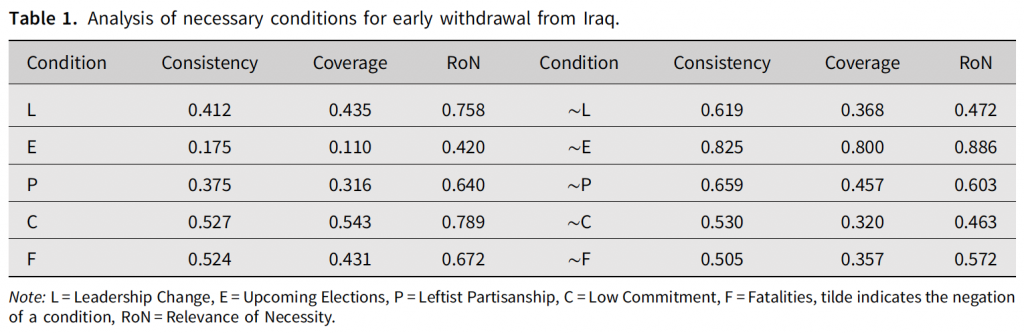
    The February 2020 issue (5:1) of the European Journal of International Security (Cambridge University Press) features the article “Paths towards Coalition Defection: Democracies and Withdrawal from the Iraq War“. The study examines democratic war involvement in Iraq across 51 leaders from 29 countries. The article is the first QCA study that covers the entire period of coalition operations in Iraq, from 2003 until 2010, across all democratic governments that were involved in the multinational coalition. Among other findings, the article challenges some previous studies’ results on the effects of leadership turnover and electoral incentives (here and here). The set-theoretic analysis documents causal heterogeneity, where multiple paths lead towards coalition defection and leadership turnover only brought about the outcome of coalition withdrawal when combined with specific other conditions. For electoral incentives, contrary to expectations derived from prior studies, it could not be shown that upcoming elections were associated with coalition defection. Finally, the article documents the importance of casualties and prior commitment as factors that had previously been neglected. Replication data is hosted a Harvard Dataverse (R script, data, supplement).

    Abstract: Despite widespread public opposition to the Iraq War, numerous democracies joined the US-led multinational force. However, while some stayed until the end of coalition operations, and several increased their deployments over time, others left unilaterally. How to explain this variation?

    While some studies suggest that democratic defection from security commitments is primarily motivated by electoral incentives or leadership change, scholars have not reached a consensus on this issue. To account for the complex interplay between causal factors, this article develops an integrative theoretical framework, using fuzzy-set Qualitative Comparative Analysis (QCA) on original data on the Iraq War involvement of 51 leaders from 29 democracies.

    The findings document the existence of multiple paths towards coalition defection. Among others, the results show that: (1) leadership change led to early withdrawal only when combined with leftist partisanship and the absence of upcoming elections; (2) casualties and coalition commitment played a larger role than previously assumed; and (3) coalition defection often occurred under the same leaders who had made the initial decision to deploy to Iraq, and who did not face elections when they made their withdrawal announcements.

    Reference:

    Mello, Patrick A. (2020) Paths towards Coalition Defection: Democracies and Withdrawal from the Iraq War, European Journal of International Security 5 (1): 45-76 (https://doi.org/10.1017/eis.2019.10)
  • Von der Bonner zur Berliner Republik

    Sammelband der DVPW-Themengruppe Außen- und Sicherheitspolitik

    In der  bei Nomos erscheinenden Buchreihe “Außenpolitik und Internationale Ordnung” (Herausgeber: Hanns W. Maull und Sebastian Harnisch) ist der von Klaus Brummer und Friedrich Kießling herausgegebene Sammelband Zivilmacht Bundesrepublik? Bundesdeutsche außenpolitische Rollen vor und nach 1989 aus politik- und geschichtswissenschaftlichen Perspektiven erschienen.

    Die Publikation ist der dritte bisher erschienene Sammelband in der “Edition Themengruppe Außen- und Sicherheitspolitik“. Weitere Bände sind Chinesische Seidenstraßeninitiative und amerikanische Gewichtsverlagerung (Hansel/Harnisch/Godehardt, Hrsg. 2018) sowie Sonderbeziehungen als Nexus zwischen Außenpolitik und internationalen Beziehungen (Harnisch/Brummer/Oppermann, Hrsg. 2015).

    Weiterführende Informationen zur Themengruppe Außen- und Sicherheitspolitik gibt es auf der DVPW-Webseite. Dort ist auch die Anmeldung zur Mailingliste der Themengruppe möglich. Der Twitter-Account ist @dvpw_aussenpol.

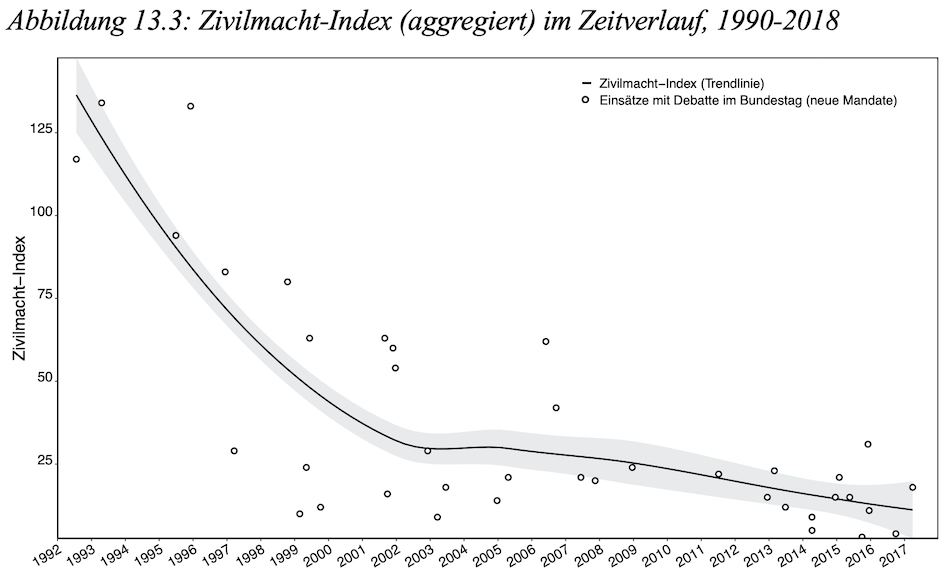
    Mein Kapitel “Von der Bonner zur Berliner Republik” (PDF) untersucht für den Zeitraum 1990 bis 2018  parlamentarische Debatten zu 40 Auslandseinsätzen der Bundeswehr im Hinblick auf deren Resonanz mit dem rollentheoretischen Konzept der “Zivilmacht”. Die quantitative Textanalyse zeigt im Zeitverlauf eine deutliche Abnahme der Verwendung zivilmachtstheoretischer Rhetorik:

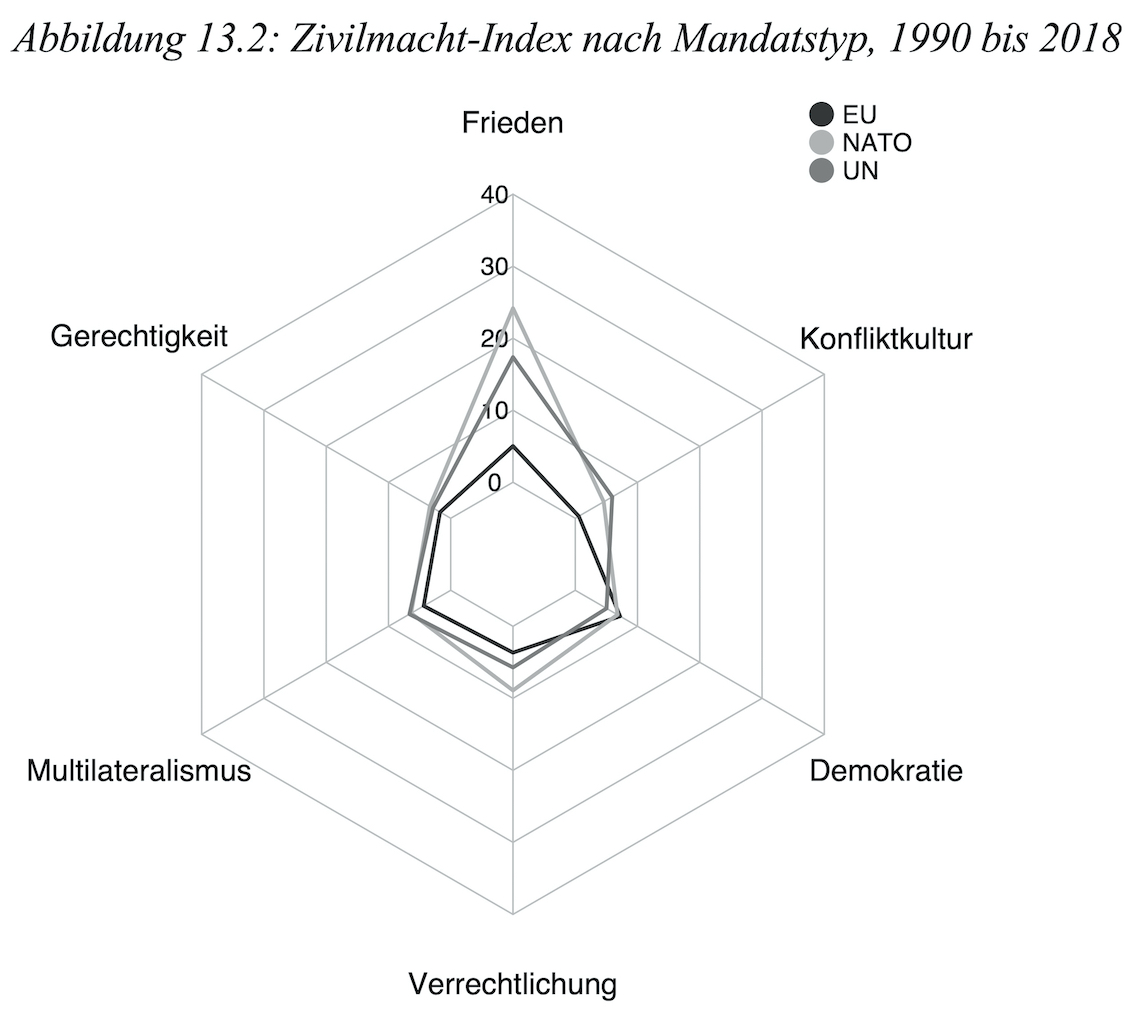
    “Während die Debatten Anfang der 1990er Jahre noch von einer hohen Resonanz mit dem Zivilmachtkonzept geprägt waren, so zeigt sich seither eine kontinuierliche Abnahme. Dies kann als Anzeichen für einen „Wandel“ in der deutschen Außenpolitik und ihrer politischen Rechtfertigung gesehen werden. Zweitens konnte die Analyse Unterschiede zwischen den Einsatztypen identifizieren. So zeigen die Plenardebatten zu NATO-Einsätzen eine höhere Übereinstimmung mit dem Zivilmachtkonzept auf als UN- oder EU-Missionen. Statistisch signifikant sind dabei die Zivilmacht-Werte der Debatten zu EU-Einsätzen, welche im Vergleich zur Gesamtheit der untersuchten Plenardebatten erheblich niedriger liegen” (Mello 2019: 310).

  • Paths towards Coalition Defection

    Article Published in the European Journal of International Security

    The European Journal of International Security (Cambridge University Press) has published a first view version of “Paths towards Coalition Defection: Democracies and Withdrawal from the Iraq War“. The open access article PDF is available here. Replication data is hosted a Harvard Dataverse (R script, data, supplement). The article examines democratic war involvement in Iraq across 51 leaders from 29 democracies. It is the first set-theoretic study that covers the entire time frame of coalition operations, from 2003 until 2010. Its counter-intuitive findings document the existence of multiple paths towards coalition defection, emphasizing the importance of casualties and prior commitment. The European Journal of International Security (EJIS), founded in 2016, aims to publish “the cutting-edge of security research”, taking a cross-disciplinary approach that seeks to cover all areas of international and global security. EJIS is a journal of the British International Studies Association (BISA).

    Abstract: Despite widespread public opposition to the Iraq War, numerous democracies joined the US-led multinational force. However, while some stayed until the end of coalition operations, and several increased their deployments over time, others left unilaterally. How to explain this variation? While some studies suggest that democratic defection from security commitments is primarily motivated by electoral incentives or leadership change, scholars have not reached a consensus on this issue. To account for the complex interplay between causal factors, this article develops an integrative theoretical framework, using fuzzy-set Qualitative Comparative Analysis (QCA) on original data on the Iraq War involvement of 51 leaders from 29 democracies. The findings document the existence of multiple paths towards coalition defection. Among others, the results show that: (1) leadership change led to early withdrawal only when combined with leftist partisanship and the absence of upcoming elections; (2) casualties and coalition commitment played a larger role than previously assumed; and (3) coalition defection often occurred under the same leaders who had made the initial decision to deploy to Iraq, and who did not face elections when they made their withdrawal announcements.