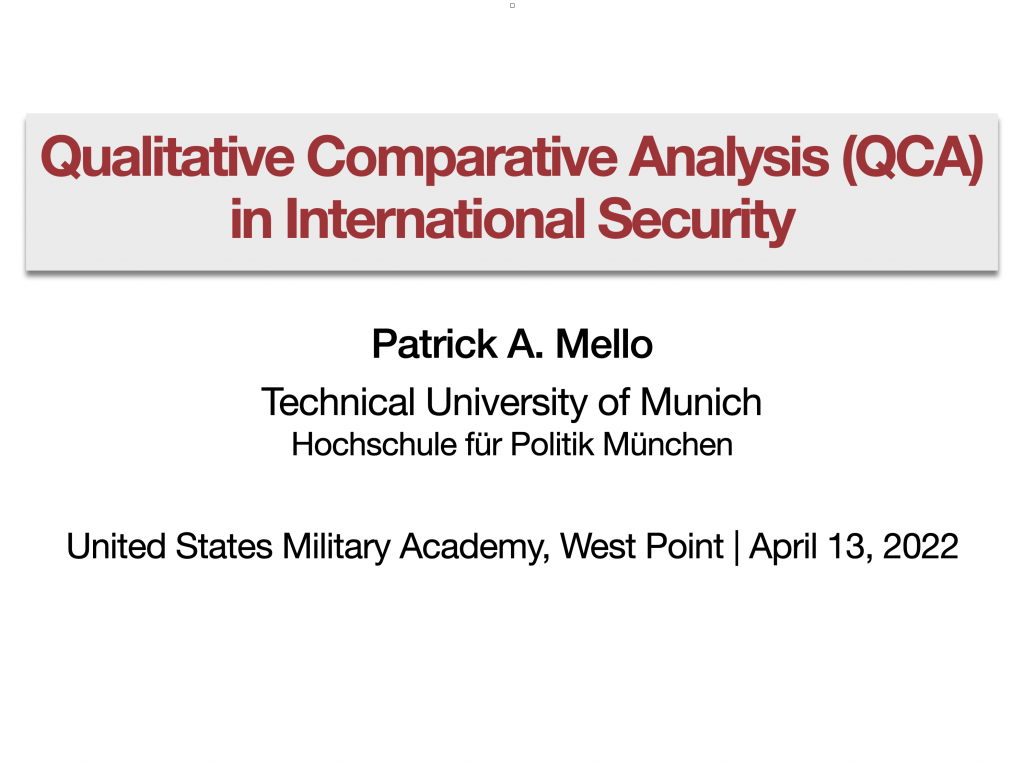
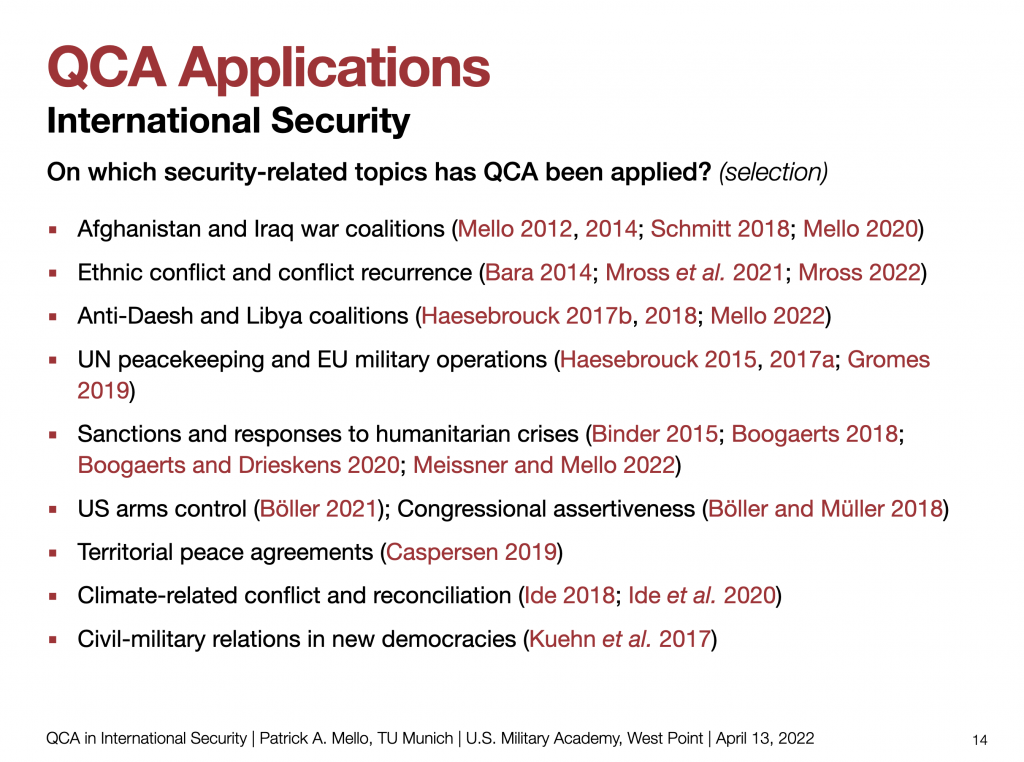
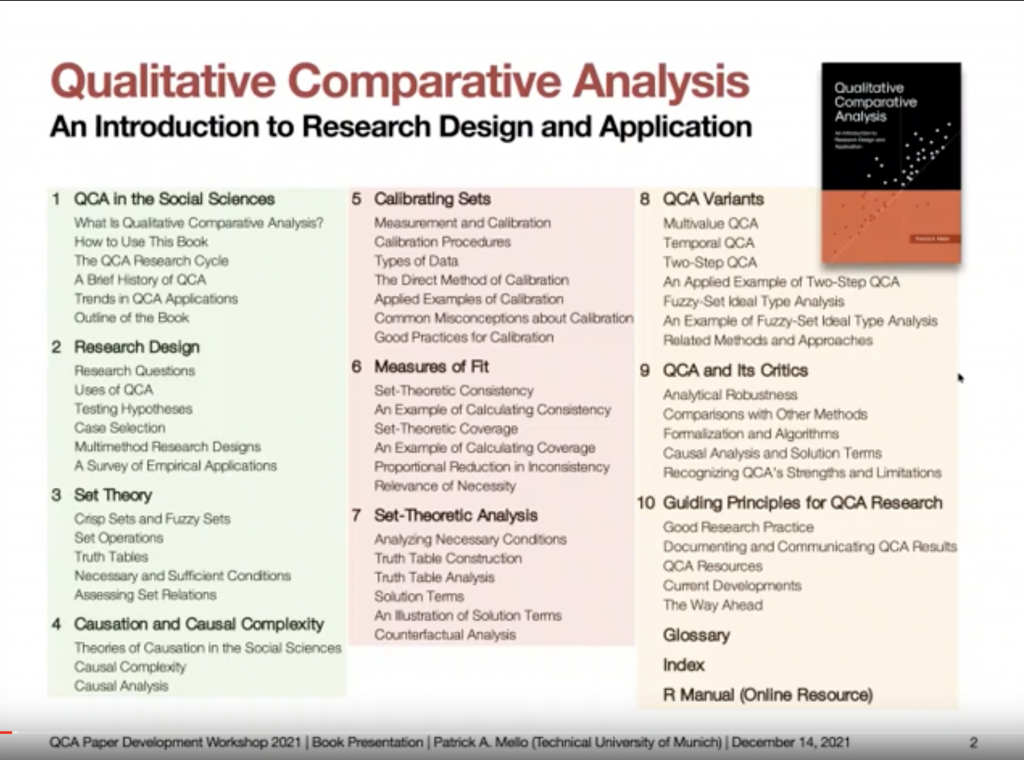
On April 13, 2022 I gave a virtual guest talk on “QCA in International Security” at the Social Science Research Lab, Department of Social Sciences of the United States Military Academy at West Point. In recent years, QCA has seen an increasing number of empirical applications on security-related topics, and IR research at large. In my talk, I gave a concise introduction to the method and its application in the field, outlined the structure of my QCA textbook, and provided an illustration of how QCA has been used to analyze coalition defection in the Iraq War. Thanks to Jordan Becker, Director of the Social Science Research Lab, and his colleagues for the invitation and the fruitful discussion after the talk!
Open Access Article Published in Contemporary Security Policy
Contemporary Security Policy published our open access article “The Unintended Consequences of UN Sanctions: A Qualitative Comparative Analysis” (with Katharina L. Meissner, Centre for European Integration Research, University of Vienna). The article examines the flip-side to sanctions, namely their unintended consequences. Empirically, we draw on data from the Targeted Sanctions Consortium to conduct a set-theoretic analysis. We complement the QCA part with case illustrations on Haiti and North Korea.
Abstract: Sanctions are widely used foreign policy tools in reaction to crises in world politics. Accordingly, literature on sanction effectiveness—their intended consequences—is abundant. Yet, fewer studies address the unintended consequences of restrictive measures. This is remarkable given that negative externalities are well documented. Our article explores this phenomenon by asking under which conditions sanctions yield negative externalities. We develop a theoretical conceptualization and explanatory framework for studying the unintended consequences of UN sanctions. Empirically, we draw on data from the rich, but scarcely used Targeted Sanctions Consortium and apply qualitative comparative analysis (QCA) to examine negative externalities of UN sanctions, complemented by illustrations from the cases Haiti and North Korea. The results document the existence of multiple pathways toward unintended consequences, highlighting the negative impact of comprehensive and long-lasting sanctions, as well as the ability of autocratic targets with economic means to persist unscathed from sanctions.
YouTube Book Summary
The COMPASSS Network made some material from the last QCA Expert Workshop at ETH Zurich available on YouTube. This includes a 20-minute summary and some Q&A on my book Qualitative Comparative Analysis: An Introduction to Research Design and Application (Georgetown UP, 2021). This part starts in minute 12 of the recorded session (see the video link below).