Qualitative Comparative Analysis at the 25th Summer School in Social Science Methods, 2021
The workshop program was announced for the 25th Summer School in Social Science Methods, organized by the Swiss Foundation for Social Science Research (FORS) and the Università della Svizzera Italiana (USI). The school is hosted at USI in beautiful Lugano, Switzerland. For the third time, I am offering a one-week intensive course on Qualitative Comparative Analysis (QCA) at the Swiss Summer School. The course runs from August 23-27, 2021. The course is based on my QCA textbook Qualitative Comparative Analysis: An Introduction to Research Design and Application (Georgetown University Press). Course registration will open at the end of January/early February 2021. The opening will be announced through the summer school’s newsletter (sign-up on the registration page).
Workshop contents
This workshop gives a thorough introduction to the method of Qualitative Comparative Analysis (QCA), with an emphasis on research design and practical application. Since its inception (Ragin 1987), QCA has gained recognition among social scientists as a case-based research method that is ideally suited to capture causal complexity. This essentially describes a situation where an outcome results from multiple pathways and different combinations of conditions. Moreover, QCA entails a rigorous and systematic comparison of selected cases and their configurations through Boolean logic and a software-based analytical protocol.
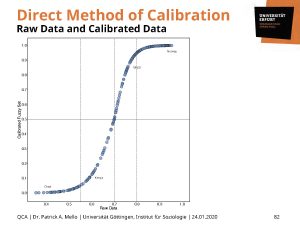
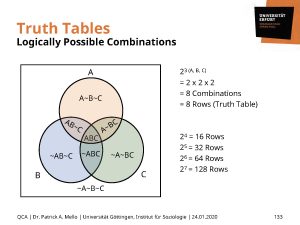
Throughout this workshop, participants will be introduced to the building blocks of QCA, while the course structure follows an ideal-typical research process. The introduction opens with empirical illustrations to show how and for what purposes QCA is being used, before summarizing the method’s key characteristics. This is followed by sessions on causation, causal complexity, and research design, to provide a foundation for thinking about empirical applications. The ensuing sessions engage with the use of QCA as an analytical approach, starting with set theory and concepts like necessary and sufficient conditions, Boolean algebra, truth tables, and fuzzy sets. In calibrating sets, we look into approaches to transform empirical raw data into crisp and fuzzy sets. Next, the course examines various measures of fit that help in evaluating QCA results. The session on set-theoretic analysis puts all of the elements together and shows how empirical data is analyzed and interpreted with QCA. Finally, the workshop closes with sessions on advanced topics, which can be tailored based on participants’ background and research interests. Potential topics include multi-method research design, QCA variants, addressing critiques, and recent developments. The workshop sessions are complemented by illustrations and exercises, using the R Software environment and relevant R Packages.